

What is Q2Q
Q2Q is a framework for moving large files and streams between peers, with a CDN as the fallback rather than the primary path. Three kinds of programs take part:
| Runs where | Does what | |
|---|---|---|
| Track | a server you host | Keeps the online index and the file index, assigns peers to a Punch, issues TURN credentials |
| Punch | a server you host | Holds a binding for each online peer, and relays signalling between two peers that want to connect |
| Peer | the client | Downloads and uploads; also the thing that decides, per block, whether to use CDN or P2P |
Track and Punch are the control plane: they help peers find each other and set up a connection, but never carry file data and never see the content.
The two planes are independent, and both are built on the same network-free core:
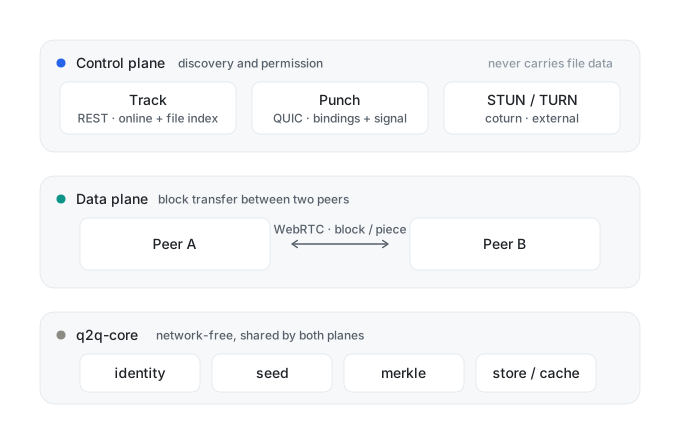
Peers then talk to those servers like this:
sequenceDiagram
    autonumber
    participant A as Peer A
    participant T as Track
    participant PB as Punch B
    participant B as Peer B
    participant C as CDN / Origin

    B->>T: announce (self-signed ticket with pub)
    T-->>B: session_key, Punch B address and public key
    B->>PB: join (join ticket + signature)
    PB-->>B: binding_id, binding_key, expires_at

    A->>T: query (info_hash)
    T-->>A: B peer_id, public key, Punch B address
    Note over T,A: no addresses, no candidates, no credentials

    A->>PB: connect (ticket: tgt=B, ih, cid)
    PB->>B: connect (same ticket)
    B-->>PB: accept
    PB-->>A: accepted

    A->>PB: offer (SDP + ICE candidates)
    PB->>B: offer
    B->>PB: answer (SDP + ICE candidates)
    PB-->>A: answer

    A<<->>B: ICE checks + DTLS handshake
    Note over A,B: DTLS fingerprint == the one carried in signalling

    A->>B: bitfield, request (block_index, count)
    B-->>A: piece × N (1024 B each, unreliable)
    Note over A: proof vs info.root → verified → broadcast have

    alt punch fails or a block is slow
        A->>T: relay_credentials (token)
        T-->>A: short-lived TURN credential
        A->>C: HTTP Range (block-aligned)
        C-->>A: bytes + leaf_hashes
    end
How a download happens
- Seed — the publisher builds an info dict (file length, block size, the Merkle root) and gets an
info_hash. Peers share it as a magnet link. - Announce — a peer tells Track "I am online, and I hold this file". Track records it with a TTL and assigns the peer to a Punch.
- Query — the downloading peer asks Track who holds the file. Track returns candidates: peer id, their public key, and the Punch that peer is on.
- Connect — the asker goes to that Punch and asks to be connected to the holder. The holder explicitly accepts or refuses.
- Offer / answer — only after acceptance do the two exchange SDP and trickle ICE candidates, through the same Punch.
- Data — once a channel is up, blocks are requested, verified against Merkle proofs, and written in place. Individual blocks fall back to CDN whenever P2P is slower or unavailable.
Why it is shaped like this
Identity is self-signed. A peer generates a keypair locally; its peer_id is derived from the public key. Nobody registers, nobody is revoked, and no server has to be asked whether an identity is real. The cost: there is no revocation mechanism, so authorisation is expressed as short-lived tickets that the peer signs for itself.
Consent comes before the offer. A Punch asks the target peer whether it wants the connection before any SDP exists. A refusal therefore costs no ICE gathering, no STUN query, and no relay allocation — which matters because most connection attempts in a large swarm are refused.
Two sources, chosen per block. Every block independently picks CDN or P2P. A peer that just joined can download the whole file from the CDN while simultaneously becoming a source for others.
Verification is end to end. Content is addressed by a Merkle root signed into the seed. A peer that lies about a block fails its proof and is dropped, so neither a malicious peer nor a malicious Punch can corrupt a download.
Terms
| Term | Meaning |
|---|---|
peer_id | base32(SHA-256(public_key)) plus a checksum — the stable name of a peer |
info_hash | SHA-256 of the canonical info dict; identifies the content |
binding | A Punch's record that a peer is reachable on a live channel |
signal_key | Symmetric key for one connection attempt; lets the asker resume after a network change |
cid | One-shot id inside a ticket; consumed when used, which is what stops replays |